
Access to communication is a fundamental human right. Yet for many Deaf and hard-of-hearing people, equal access to education, employment, public services, and civic life remains limited due to a shortage of well-trained, ethically grounded sign language interpreters. SignUnity was created to respond to this challenge.
SignUnity is an international Erasmus+ Capacity Building in Vocational Education and Training (CB-VET) project that brings together partners from Europe and Sub-Saharan Africa to strengthen vocational education and training for sign language interpreters. At its core, the project stands for access, skills, and inclusion—three interconnected principles that guide all activities and outcomes.
Access is the starting point of SignUnity. Without qualified interpretation, Deaf and hard-of-hearing people face systemic barriers in education, healthcare, justice, employment, and public life.
SignUnity works to:
Improve access to high-quality sign language interpreting services
Support the professionalisation of interpreting as a recognized VET pathway
Reduce inequalities in access between regions with well-established training systems and those where formal interpreter education is still emerging
By strengthening interpreter training structures and promoting shared standards, SignUnity contributes to more equitable access to information and services across borders.
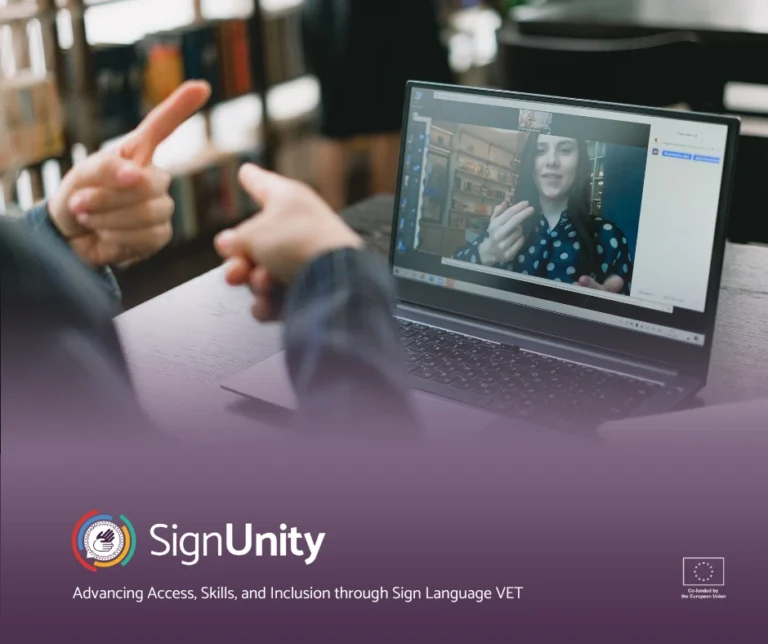
High-quality access depends on high-quality skills. SignUnity focuses on strengthening both technical competence and ethical professionalism in sign language interpreting.
The project aims to:
Co-develop a modern, competence-based VET curriculum for sign language interpreters
Strengthen pedagogical capacity among VET educators and trainers
Promote a shared understanding of professional ethics, quality standards, and responsibility
SignUnity goes beyond language skills alone. It addresses:
Interpreting ethics and confidentiality
Cultural and community awareness
Professional conduct and continuous learning
Digital and blended learning competences
Through these elements, the project supports interpreters not only as language mediators, but as key actors in inclusive societies.
Inclusion is not an add-on—it is a guiding principle. SignUnity places Deaf and hard-of-hearing communities at the heart of the project, recognising them as rights-holders, experts, and partners.
The project promotes inclusion by:
Ensuring that Deaf perspectives inform curriculum design and standards
Strengthening cooperation between training institutions, interpreters, and Deaf organisations
Supporting culturally and linguistically appropriate approaches across regions
By reinforcing the link between interpreter training and the real needs of Deaf communities, SignUnity contributes to more trust, quality, and accountability in interpreting services.

One of SignUnity’s strongest assets is its cross-regional partnership, bringing together organisations from Europe and Sub-Saharan Africa with complementary experience in:
VET and interpreter education
Deaf community advocacy
Linguistic and sign language research
Digital education and e-learning
This cooperation allows partners to exchange knowledge as equals, address regional gaps, and co-create solutions that are adaptable, sustainable, and context-sensitive.
Through its focus on access, skills, and inclusion, SignUnity aims to generate impact at multiple levels:
For learners and interpreters: improved training quality, clearer professional pathways, and stronger recognition
For VET providers: modernised curricula, digital tools, and strengthened teaching capacity
For Deaf communities: better access to qualified, ethical interpreting services
For systems: stronger alignment with inclusive education and employment policies
Ultimately, SignUnity contributes to a future where communication barriers are reduced, professional standards are strengthened, and inclusive participation becomes the norm rather than the exception.

Funded by the European Union. Views and opinions expressed are however those of the author(s) only and do not necessarily reflect those of the European Union or the European Education and Culture Executive Agency (EACEA). Neither the European Union nor EACEA can be held responsible for them.